Showing posts with label gold. Show all posts

Thursday, November 26, 2009

Will China go the Japan way …

During Obama’s visit, China secured everything it wanted – the political dividends of funding $800 billion debt to an ailing US economy. Having locked the US into economic inter-dependence, it also used American vulnerability to legitimise a much larger role for itself. Hitherto China was the greatest champion of “national sovereignty” which it deftly contrasted to the West's intrusiveness. The seemingly innocuous reference to India and Pakistan marks a new willingness to step into an emerging void. China is not going to flex its muscles in a hurry. It has set the markers for a new, global architecture of power that will follow its inevitable emergence as the world’s biggest economy. India has reason to worry. (via China has tamed India with help from Obama – The Times Of India).

The US strategy

Most ‘future-of-China’ debates are incomplete as they miss a very important element - the American template for co-opting client states. Let us call this as US-Client-Acquisition Programme (USCAP). The outcome and China’s economic future is tied to access to US markets, capital, technology, businesses – very closely.

The US has successfully executed US-Client-Acquisition-Programme (USCAP) a most out-sized ‘conquest’ in history. By using these economic levers, it has successfully created client states across Europe, SE Asia, Japan, etc. Some economies have taken the bait, used US incentives and become ‘successful’ client states.

Some prospective clients states have fallen by the wayside. South American failures, the Middle East, Pakistan, post-Gorbachev Russian reluctance have been signal failures of American recruitment.

The strategy has 5 five corner-stones: -

  1. High dollar value – vis-a-vis the client state currency.
  2. Export led growth
  3. US multinational corporate investments
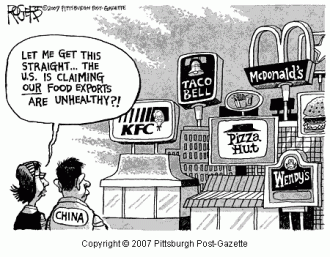
  4. US soft-power is allowed unimpeded run (Hollywood, Rock & Roll, Coca Cola, McDonalds, etc.)
  5. US enemies are the enemies of the client states

The most ambitious target and the biggest challenge in the execution of this strategy is China. But before we examine China, we need to see the US pattern of recruitment and involvement.

In the aftermath of the WW2

After nearly 6 years of WW2, Europe was prostate, more than 25 million killed (including the Holocaust). European economies were shattered. 10 years after WW2, Europe lost most of its colonies. In the midst of this, the US stepped in with the Marshall Plan and IBRD. Most European currencies were set on at a low exchange rate, exports to the USA were boosted, and Europe made a comeback.

In return for US aid, Europe agreed to be a junior partner in the NATO alliance. Unlike most overlords and masters of the past, under the USCAP allowed significant leeway to their European client states in matters of culture, language, political, economic and religious freedom. The US yoke around the European necks was never too heavy or irksome. Mostly.

Italy, Germany, France, Austria, Sweden, Denmark, The Netherlands made a brilliant recovery. The only laggard was Britain – living on past glory and trying to unwind the past, at the same time. As European economies stabilized, the US ‘allowed’ European currencies to appreciate against the dollar, triggering 25 years of economic stagnation in Europe.

The end of the Japanese miracle

As European success stabilized, US turned its attention to Japan. The Japanese star started ascending in the 70s. From the 80s, right upto the 90’s, the business and economic world were agog with the coming of the Japanese. The ‘Japan-MITI-keiretsu-Quality management system’ combination seemed unstoppable. The world waited with bated breath for the Japan to rail-road everyone else. Every businessman, first tried to learn Japanese etiquette.

Hollywood made films showcasing Japanese business and economic systems – like Black Rain (Michael Douglas teaches a few things to the Japanese Yakuza and the Tokyo Police); Die Hard (Bruce Willis fights terrorists in Nakatomi Plaza), Rising Sun (Sean Connery, Wesley Snipes investigate murder in an American subsidiary of a Japanese company).

1973-1985. The Japanese were strutting on the world stage. In their hubris, one Japanese businessman declared that the only world class product made in USA was maple syrup.

From ‘The myths of Japanese quality; By Ray E. Eberts, Cindelyn G. Eberts’, Page 141

In business schools, Japanese management was the first lesson and the last word. Companies like Xerox, Fedex, Motorola adopted various ‘QIP’ systems – quality improvement processes. The miracle of European Reconstruction and EU was not even in the consideration set any more. The USSR was still a power to reckon with. Berlin Wall looked like a permanent fixture across the heart of the Western world. And the Japanese manufacturing juggernaut seemed unstoppable.

Falling cherry blossoms

Finally, the Americans decided to bell the cat – and the yen-dollar exchange rate was rejigged. The American government put pressure on Japan’s politicians and central banking officials to raise the value of the yen against the dollar. Some U.S. industries, anxious about their eroding share of world markets, put political pressure on American politicians. With some support from academic economists, American producers argued that a higher-valued yen would help their products sell better in competition with Japanese products and therefore reduce the American trade deficit.

In 1985, the US worked out a deal, whereby the US dollar was devalued, without a formal devaluation. The dollar was allowed to sink against the Japanese Yen – only it was not called a devaluation, but was called the Plaza Accord. Whereby the dollar would be allowed to depreciate against other currencies – especially the Japanese Yen. Intense negotiations spread over nearly a decade followed. During crucial and intense negotiation with Japan, in 1992, George Bush Sr., vomitted and fainted.

Endaka – and the end of the Japanese run

After the Plaza Accord, the Japanese team went back home and prepared their industry for endaka – high yen prices. From August 1971 through April 1995, the yen’s value ratcheted up from 360 to the dollar to 80 to the dollar. In 1993, for the first time, a non LDP Government was formed in Japan – The Shinseito (Japan Renewal Party) came to power.

And the Japanese goose was truly cooked.

Net outcome, by the mid 1990s, the Japanese juggernaut was halted. Japan had to remain contented with being the world’s second largest economy. George Soros thought,

the prospect of Japan’s emerging as the dominant financial power in the world is very disturbing, not only from the point of view of the United States but also from that of the entire Western civilization

For the next 10 years, the Japanese economy stagnated, investments stagnated. Their dream of supplanting the US as the world’s largest economy were over – for now at least.

Stuffed Tigers

After Japan, the 90s was decade of the Asian Tigers – Korea, Malaysia, Thailand, Indonesia, Singapore were all set to replace Japan as the ‘new axis’ of world economy. India especially came out as a clumsy plodder against these countries. Lee Kuan Yew, held forth on the Indian character as faulty – and could not compete with the Chinese-Confucian value-set. Commentators tripped over themselves, predicting an Asian century.

Then followed the Asian Crisis. Mahathir Mohammed claimed that the 1997 Asian Crisis was a foreign conspiracy. Specifically, he named George Soros as the master mind behind the Asian Crisis. 9 years later, Mahathir made up with George Soros – and retracted his charge.

The ostensible reason for the Asian crisis was that investors in the Asian Tigers were funding long term investments from short term borrowings – a classic mismatch. The rapid withdrawal of foreign funds impacted development of these economies to the extent of a decade.

The real reason possibly was in the scheme of USCAP things, the US had turned its attention to the Chinese recruitment.

The 2 trillion trap

Similar to the success of the Europeans, the Japanese, Koreans and the Asian Tigers, China too has embraced the US-client state model. Booming exports to the US, massive FDI by the US in the Chinese economy, has put China in the earlier position of Japan and Korea – prime sub-contractors to the US economy. Where the Chinese economy seems to ‘partially different’ is the military side. On foreign policy and ‘American’ culture, the Chinese have been ’superficially’ resistant and nominally ‘assertive’.

The Chinese miracle, much like the ASEAN, Japanese and European miracles before, is using exports to the USA as a stepping stone. Chinese growth and expansion depends on access to the US markets and a devalued currency. For how long will the US allow the Chinese to do that? Another 5 years – or is it 10 years. Was Obama’s China visit, the first round – in a 50 round bout, spread over the next 7 years?

What is China's future ...

The US dollar-renminbi tango will continue over the next 5-7 years. US pressures will be steadily increasing pressure on the Chinese. After the Asian crisis, China was in a much better position to resist American pressure for renminbi revaluation. That resistance to renminbi revaluation, in turn, caught China, in another trap. China has US$ 2 trillion worth of rapidly depreciating foreign reserves.

Which brings us to India!

What will it be

What are the threats to the Indian economy! Will it be a ‘sudden’ collapse in software and outsourcing? Or will it be a severe contraction in gems and jewellery exports? Can it be a a 3 year drought due to global warming? Many in India are panting for the day, when the US will deign to look India-wards and make India also into a client state.

Most recently, we had the privilege of Shashi Tharoor, our Honourable Minister, who sees India replacing Israel in the US camp!

Monday, November 16, 2009

Another apology. This time for kids shipped from Britain to colonies

Demonize, Genocide - and apologize

Lovely cartoon.

Prime Minister Kevin Rudd issued a ... apology Monday to ... British children shipped to Australia with the promise of a better life, only to suffer abuse and neglect thousands of miles from home.

At a ceremony ... attended by tearful former child migrants, Rudd apologized for his country's role in the migration and extended condolences to the 7,000 survivors of the program who still live in Australia.

"We are sorry," Rudd said. "Sorry that as children you were taken from your families and placed in institutions where so often you were abused. Sorry for the physical suffering, the emotional starvation and the cold absence of love, of tenderness, of care. Sorry for the tragedy - the absolute tragedy - of childhoods lost." via (Apology for kids shipped from Britain to colonies).

The Daily Express adds: -

there is growing anger that the British government should have been the first to apologise ... who sent the children there in the first place ... aimed at relieving the burden on Britain’s children’s homes and filling Australia with “good white stock” ... the children were sent to Australia without the knowledge or consent of their parents and were told – falsely – that their mothers and fathers were dead ... many of them were institutionalised in religious or charitable organisations where they were subjected to neglect and abuse ... Under pressure from those whose lives were ruined by child migration, Gordon Brown ... said, “the time is now right” for the UK to apologise for the actions of previous governments. “It is important that we listen to the voices of the survivors and victims of these misguided policies.” (ellipsis mine).

This made me think …

About, the ritual of regret and apology, about their role in the genocidal past. Since, the “Jewish Problem” was solved by Hitler (there are hardly 1 million Jews left in Europe and 5 million in USA), the West and USA has no problems, anymore with the Jews. Australia, Canada and France have tendered their ritualistic apologies – and start demonizing someone else.

Australia struggled for more than 5 years – before they agreed to apologize. I presume, US (to the Native Americans and the Blacks), Belgium (to Congo), Britain (to Kenya), France (to Vietnam), Spain (to the Native Americans), et al will all apologize. A book, The New Rulers of the World, examines the denial of the genocide.

Is this an aberration? Is this nightmare over?

Franz J. A. Romer, Duesseldorf, a 2ndlook blog reader informs us,
In Germany it is all about deduction (removal) of children from their family due to a local town system which is called Jugendamt (in other countries called youth welfare systeme). The Jugendamt is a local authority with no given functional control structure but a depending lawfull structure.It is absolutely easy for the Jugendamt to deduct the cildren into foster families or homes.

Hitler was never alone

Hitler’s biggest mistake – he lost the war.

The genocide with which his regime was charged with was also carried out against the Native Americans in the USA, the Australian aborigines, in Congo by the Belgians.

Post colonial Governments in Kenya and India have ignored the cover-up of the millions killed by the colonial rulers – in the Mau Mau operations in Kenya or the 1857 War in India.

The 'real' Roma Gypsy story

In Europe, kidnapping children was considered legal for most of 1500AD-1750AD. On one condition – you had to kidnap Roma Gypsy children! More than 25,000 children kidnapped. No problem. Everybody sleeps peacefully at night. Switzerland was doing this till 1973!

The Romani Gypsies, Sinti have been a favored European target for the last 500 years – by the Vatican, by the Protestant Church, by monarchies and by Republican Governments. In war and and in peace.

Their crime. They civilized (?) Europe. No less.

Looking at the Anglo Saxon Bloc

Linked to this is the fact at the end of WW2, the Anglo Saxon Bloc controlled 90% of gold production and reserves. The largest private gold reserve in the world, India was still a British colony. The Anglo Saxon bloc has 3 of the 4 largest countries of the world; wiped out native populations in these 3 countries, acquired these countries by force, sequestered the world’s natural resources and are united by their will to dominate and exploit the rest of humanity.

They control more than 67% of world gold production and more than 80%, if you include Anglo-Saxon countries, colonies and companies (like Anglo Gold, Barrick, BHP, Rio Tinto, etc).

The interesting question is why do Australia and Canada cling to British skirts?

Modern day demonization

The Western campaign aimed at the demonisation of Islam has replaced the Jewish demonisation (Shakespeare joined in with his anti-Semitic Merchant Of Venice). Without taking responsibility for the destabilisation of the Islamic World by the liquidation of the Ottoman Empire after WW1 – perpetrated by Anglo Saxon countries and the French.

The insistence and resistance

Coming back to the apologies? I have always wondered, why this Western resistance to apologies? I also wonder what difference does an apology make to the victims, as though, the apology is worth anything.

Would an apology from Hitler be worth anything?

Sunday, November 15, 2009

US thieves nabbed - Indians households targetted for gold

courtesy Gary Varvel, Indy StarIs this why Indians prefer gold ...? Cartoon courtesy Gary Varvel, Indy Star.

Law has finally caught up with a ring of picky burglars who had been targeting South Asian families in a Washington DC neighbourhood for their gold.

Indian American residents of Fairfax, a suburb of the national capital in neighbouring Virginia, expressed relief as the police arrested two men and a woman from the New York City area in Centreville. Police suspect the burglars hit 26 homes in Fairfax and three more in Loudoun County since January. Each time, the burglars struck they ignored silver, gems and electronics, taking only gold jewellery, saris with gold threads and gold statues.

Police said they believe gold was being stolen because it is selling at more than USD 1,000 an ounce. But they don`t know how or why certain houses, mostly in the Fair Oaks, Reston and Centreville areas of western Fairfax, were targeted. (via Zee News - Robbers nabbed for targeting desis for gold).

Will Indians ever change. They go to the opposite side of the world - and become famous for their gold! Indians and gold - a never ending story!

Sunday, November 8, 2009

RBI to buy 200 tonnes of IMF gold

RBI’s decision to shore up its gold reserves needs to be seen in the context of other central banks across the globe increasing their gold reserves. Among them are the central banks of China, Russia and a few countries in the European Union.

In the last one year, China has increased its gold holdings, by weight, by 75.69%, Russia by 18.78%, the Philippines by 18.50% and Mexico by 108.91%.

Compared with this, India’s central bank did not add anything to its gold reserves in the last one year, according to Bloomberg data. (via RBI to buy 200 tonnes of IMF gold – Home – livemint.com).

Two years ago …

2ndlook had estimated that the Chinese could possibly (and they have) increase their monetary gold reserves. On April 24th, 2009, Bloomberg reported that China had increased

its (gold) reserves by 454 tons to 1,054 tons through domestic purchases and refining scrap metal, Hu Xiaolian, head of the State Administration of Foreign Exchange, said in an interview with the Xinhua News Agency today. China, the world’s biggest gold producer, has increased its holdings before, Hu said in the interview carried on the administration Web Site. They rose from 394 tons to 500 tons in 2001 and to 600 tons in 2003. The U.S. has the world’s biggest gold holdings at 8,134 tons, followed by Germany with 3,413 tons, World Gold Council data show. France has 2,487 tons and Italy 2,452 tons, while the IMF has 3,217 tons, according to the council.

Another report, from Market Watch, a WSJ web publication added,

The increase makes China the world’s fifth-largest holder of gold, just ahead of Switzerland, and among the six nations plus the International Monetary Fund that have reserves of more than 1,000 metric tons. Although Hu did not elaborate on where China had sourced the additional bullion, her comments were interpreted as meaning they came from domestic sources and may included refining of scrap metal. Traders also say the gold was accumulated systematically over a number of years. Last year China ranked as the world’s largest gold producer with 12.2% of world output, equivalent to 288 metric tons. The U.S. ranked second with a 9.9% share, or 234 metric tons.

What are the future plans of the Chinese? A report quotes an analyst

China should increase its gold reserve from 600 tons to about 2,500 tons in a short term and to 3,000 tons in a long term to cope with the versatile exchange rate risks, said Teng Tai, an economist of China Galaxy Securities Company.

Exactly …

This really does not mean much – except that it may keep gold prices on boil. Whether a currency is backed by 5% or a 10% gold reserve makes no material difference, especially in this era of rampant use of (not just by the US of A) “a technology, called a printing press” as an economic tool. For long term economic stability, gold needs to be in the hands of individuals – and not Governments.

Why India

Since China is a significant gold producer by itself, it may not get a shot at buying IMF gold. India has negligible domestic gold production -and was possibly therefore given preference by the IMF. Of course, preference may have been given to RBI’s purchase, given its ‘responsible’ and ‘mature’ behaviour during the current Great Recession.

What does RBI’s gold purchase mean

RBI’s gold purchase means two things.

The Indian Government which has had a rather low percentage of gold holdings as their currency reserves will now bolster these reserves. Even after this purchase, Indian official reserves, will only be the ninth largest in the world in absolute terms.

On average, countries hold about 12.6% of their reserves in gold, up from 9.9% a year ago. Some of this represents an increase in gold holdings, but another driver of the increased proportion is the rise in the value of gold. (from India propels gold to new high.)

The overhanging threat of open market sales by the IMF, speculated by many and discounted by 2ndlook, now stands neutralized. This will be a kicker to gold prices in the short term.

The ideal thing …

Sell gold to individuals. Governments should not have such large holdings of gold. Gold in the hands of Governments is the prime cause of war. Gold holding should be widely dispersed, as widely as possible, amongst individuals – like the Indian gold possession model. No national government, in the new financial architecture should be allowed to have more than 250 tons of gold – to progressively reduce to 50 tons.

Tuesday, September 8, 2009

U.S. Leads World In Foreign Weapons Sales – Report – NYTimes.com

Citing a congressional study released on Friday, the Times said the United States was involved in 68.4 percent of the global sales of arms.

U.S. weapons sales jumped nearly 50 percent in 2008 despite the global economic recession to $37.8 billion from $25.4 billion the year before.

The jump defied worldwide trends as global arms sales fell 7.6 percent to $55.2 billion in 2008, the report said. Global weapons agreements were at their lowest level since 2005. (via U.S. Leads World In Foreign Weapons Sales - Report - NYTimes.com).

US in the Post WW2 world

In South East Asia from 1950-1975, Israel from the 1960 onwards and now in Iraq, Afghanistan, the US has been the in the middle of most expensive conflicts (measured in terms of lives lost) in post WW2 world.

This model of international relations is something that needs to change. The poor in this world has not become much safer, seen more democratic or significantly more richer. What justification does this policy have - apart from "I have muscles and can you stop me from flexing them" logic?

Gold - a non-military solution

As I see it, there are two simple solutions. One - everyone who disagrees with (or even if you are worried about the economic consequences of) the US foreign policy should go out and buy gold. This will surely trigger a collapse of the US dollar. Just a 100,000 people buying a 100gm of of gold in the next 1 year will trigger the dollar collapse.

Drill for oil

The second solution will need more time and will need co-operation foron the BRIC Governments. The BRIC Governments must go out and drill oil wells all over the developing world. The collapse in oil prices will remove the petro-dollar funding of the US and simultaneously eliminate /reduce the trade deficit of the developing world.

Sunday, August 30, 2009

Ben Bernanke’s version of history blames the victims

But for Bernanke...

For Bernanke, central bankers were the heroes. In the face of irrational hordes, they offered liquidity and a host of innovative policies, ensuring that financial panic did not lead to a new Great Depression. In Bernanke’s word, “the outcome could have been decidedly worse”.

His assessment isn’t exactly wrong. But as a historical record it is incomplete and far too generous to central bankers. (via Ben Bernanke’s version of history is incomplete – Telegraph).

It ain’t the first time

Helicopter Ben has a way with history. Earlier he created the concept of ‘savings glut’ – thinly blaming China ( and others) for saving money! He explained how,

“a significant increase in the global supply of saving–a global saving glut–which helps to explain both the increase in the U.S. current account deficit and the relatively low level of long-term real interest rates in the world today.”

This time around he was congratulating Central Bankers and policymakers

“in the United States and around the globe responded with speed and force to arrest a rapidly deteriorating and dangerous situation.”

Awesome! The man is so brazen! He has no shame!!

Of course, he makes no mention how the current Great Recession first came about by printing too much money – and then keeping interests low. Edward Hadas is right in one thing at least! He says, “Those who spread kerosene should not take too much credit for putting out fires.”

Benny Boy – That is good advice. Take it.

Monday, August 24, 2009

Resolving global imbalances aka currency manipulation

The Obama administration is increasingly signalling that the US will not continue to be the world’s consumer and importer of last resort. The clearest statements came last month from Larry Summers, White House economics director, in a speech at the Peterson Institute for International Economics and in an interview with the Financial Times. The US, he said, must become an export-oriented rather than a consumption-based economy and must rely on real engineering rather than financial wizardry.

This long-run vision for US growth entails greater exports and probably a smaller current account deficit than where it is now (about 3 per cent of gross domestic product). Although Mr Summers did not and could not say so, the vision will require an end to the remaining overvaluation of the dollar.

Put starkly, Mr Summers has stated that China can no longer behave like China because the US intends to behave much more like China. The world economy cannot have two, or even one-and-a-half, Chinese growth strategies from its two most important economies. Which will prevail? (via Fred Bergsten & Arvind Subramanian: Resolving global imbalances).

In the last 50 years, the US dollar has swung from being grossly overvalued to slightly overvalued. The inertia of the Bretton Woods system has kept this overvaluation going. How has this benefitted the US?

It has allowed the US to use its overvalued (and over-printed) currency to vast tracts of world economy. And now having captured these segments of the world economy (especially raw material sources), with an undervalued currency, it will achieve two objectives.

The US is in no position to pay off its nearly US$4 trillion, it owes the Rest of the World - equal to about 1 years GDP (my estimate, in PPP terms). This kind of dollar devaluation does three things at one stroke.

One - It reduces the real value of its debt. The Chinese, the Rest of BRICS and the Others need to be paid a lot less in the future. (as pointed out earlier in various posts linked here.) Two - It makes US exports artificially competitive. (as pointed out earlier in linked posts). Three - The US competitiveness will be anchored to assets purchased with over-valued dollars.

Readers can take courage from the fact that each such 'process' gives the US lesser returns and fewer options. The Law of Diminishing Marginal Utility. Or in plain language 'crying wolf' often never paid off.

But the smart answer is to go out and buy one kilgram of gold. If each reader of Quicktake and 2ndlook blogs were to do this, the world would become a safer and faier world in the next 10-20 years.

Swear!

Friday, August 14, 2009

Global warming's got me thinking

Carbon credits ... anyone?

a call has been given by Al Gore that there should be an immediate moratorium on coal fired power plants. Look at how this will impact India. More than half of the 8,00,000 mega watts of power India plans to produce by 2030 are to come from coal fired plants. Simply because India has abundant coal resources.

What most western analysts don't realise is nearly 600 million Indians do not have regular and formal access to any source of electricity. If comparison is to be drawn, it is a bit like the entire US population and half of the European Union going without any electricity.

Can you estimate the enormity of this problem? This is what Prime Minister Manmohan Singh told George Bush at the G-8 summit in Japan last year when America tried to force India to commit carbon emission cuts. India merely said it will keep its per capita emmissions at below the world average. (via Carbon emmisions and Democracy!:Wisdom by Hindsight:MK Venu's blog-The Times Of India).

What if

The entire global warming debate is just a facade to keep up demand for oil from India and China. The opposition to coal fired power plants is to stop India and China from reducing the growth in oil consumption.

After all practically all of British GDP today is declining North Sea oil and British Petroleum. Apart from Chinese money, the other source of liquidity which keeps the US afloat is petro dollars.And the US future is so closely linked to Arctic oil.

If India and China were to reduce their reliance on oil, leading to a price collapse, the biggest losers will be the Anglo Saxon bloc.

Makes one think!

Thursday, July 9, 2009

Radically rethinking Indian agriculture

In recent weeks, there have been growing apprehensions that the monsoons of 2009 will fall short of normal. This has again raised fears of rising food prices, collapse in rural incomes and possibly farmer suicides. Many a tear will be shed for rural India. Predictably, there will calls for greater support for the agriculture sector in the form of subsidised fertilisers/pesticides, cheap electricity for pumping ground water and farm loan waivers. We have been doing this now for generations now and our impoverished farmers still commit suicide. Surely, it’s time to rethink this strategy. (via Sanjeev Sanyal: Radically rethinking agriculture).

The Good ...

Sanjeev Sanyal's article does raise some interesting points - and usual points. After a promising start he then loses his way half way through.

He demolishes the idea that "the route to prosperity in rural India lies in accelerating farm production. Agriculture ... contributes 16.5 per cent of the economy ... great exertion ... cannot ... (make it) grow much more than 3 per cent per annum on a sustained basis (when the rest of the economy routinely does 7-8 per cent)."

He correctly points out that "India ... produces enough food to feed itself but ... 20 per cent of output is wasted (a) problem ... of distribution and storage, (and with) population growth is now 1.6 per cent per year ... we need to grow production by no more than this rate. ... we should ... slow agricultural growth ... if we do not want ... greater wastage or a structural price decline ...a buffer for drought years ... is better management of bumper crops rather than ever more production. India should shift focus from increasing agricultural production to improving its efficiency (with) investment(s) ... in storage and distribution."

His best one is the warning that "farming comes with a large environmental cost ... the Green Revolution is anything but “green”. Current farming techniques are severely damaging to the environment through the depletion of ground water, conversion of forest land and over-use of pesticides, fertilisers and other chemicals ... sacrificing the long-term viability of the farm sector. It ... made sense in the ‘70s to force a level-shift in food-grain production but why should we be still sacrificing the food security of future generations?"

He reminds us that "it makes ... sense to strictly conserve ground water and use it only when the monsoons fail. Special attention should be given to water management (as opposed to extraction). Agriculture consumes 80 per cent of the country’s fresh-water in order to produce just 16.5 per cent of GDP ... poor use of a scarce resource."

The Bad ...

After such good work, he succumbs to the banal - with some usual conclusions. He thinks that,

very large investments in water systems are needed to maintain even the current growth path.

Large investments in water systems are a bad, imported idea. India's successful water management model is the nearly local 500,000 water bodies - ponds, lakes, anicuts, barrages, bunds, talabs, bawlees, wells. These water bodies stored surface water - and sustained Indian agriculture for the last 2000 years. Post-colonial India's quest for Nehruvian "temples of modern India" spurred huge and wasteful investment in large hydro-electric dams. Reviving Indian water systems and rivers will take some 10 years and Rs.25,000 crores. About the cost of two large dams.

With around 70 per cent of the population still in the villages, it is absurd to hope that such a small and slow-growing part of the economy can bring salvation to such a large population.

Mr.Sanyal, you should consider the following, before you make such a sweeping statement. With the declining power and use of the dollar, the US is fighting a losing battle against agricultural subsidies. The US depends on less than 50,000 corporate 'farmers' for 50% of ts production. These corporate 'farmers' will abandon agriculture at the first sign of reduced subsidies. Over the next 20-30 years, this leaves India (and Russia) to cater to global food shortfalls. The Western industrial model is in its sunset phase. The Indian agricultural model can be the big winner in the next few decades - under the right stewardship.

And in the meantime, he himself follows up with an observation, "studies by economists like Dipankar Gupta suggest, non-agricultural activity already accounts for around half of rural India’s economy and provides employment to 35-45 per cent of the rural workforce."

Third, encouraging agricultural growth for exports in not a viable option for India. Export of agricultural products is tantamount to export of water. International trade may make sense for some niche products like tea or for managing natural cycles in food-stocks. However, it cannot be a central strategy for a water-starved country like India. It is especially careless to be thinking about exporting water when climate change may be putting even current supplies at risk.

As pointed out earlier, both water management and agricultural exports is something that is both feasible and sensible thing to do. This is something that India must prepare itself for.

The truly ugly

Meanwhile, policies should be aimed at encouraging the process of moving the rural economy away from agriculture.

The Ikshavaku clan, (of Ramchandra in the Ramayana fame), became a ruling family for developing the agricultural strain of sugarcane. Bhagwan Krishna came to be known as Natho, for domesticating wild bulls. Balarama is the 7th avataar of Vishnu - whose 'weapon' was the plough - the founder of Indian agricultural practice.

The Indian agriculturist has made a remarkable recovery after the colonial collapse - and he may still surprise you.

The aspirations of rural India have already shifted — the literate children of subsistence farmers want real jobs, not pesticides. Why should we stop them? However, this requires a big shift in policy mindset. For instance, we need to shift from a regime of cheap but irregular power supply (which may work for irrigation) to one that is fully-priced but regular (necessary for the non-farm sector). This is our best bet for making India drought-resistant.

After ceaseless bombardment of advertising, with Indian languages weakening due to massive Government subsidies to English language education, is the movement to urban lifestyle a surprise? Not to me Mr.Sanyal. Though, why you are surprised, Mr.Sanyal is a puzzle to me. We need to invest in rural India. Currently rural credit is way below its contribution to GDP - and the low price realizations for agricultural output makes the case for investments stronger.

Next, we need to revisit general governance in rural India. The traditional structures may have worked for subsistence farming (even this is debatable) but they will not support large investments in industry, construction and services. The government needs to focus on how to deliver policing, enforcement of contracts, property rights and so on.

This is about shifting from a world of farm-loan waivers to one that can support large-scale mobilisation and investment of capital in these areas. The Naxalite movement that affects a fourth of India is not due to the failure of agriculture but the failure of governance. At the same time, note that the cause of property rights and governance is not served by the indiscriminate use of “eminent domain” to acquire large chunks of land for so-called SEZs.

When you refer to 'traditional structures', are you talking about 'general governance' of the colonial Raj - that post-colonial India continued with? Or are you talking about the pre-Raj structures? The Indian peasant was the first and the only peasant in the world to own his property - till 'Desert Bloc' rulers started a 800 year trend of 'landgrab'. Yes. India does need to re-visit 'general governance'! We need traditional governance - and not the 'modern' colonial baggage, that India has not discarded.

We need to give back the lands that were grabbed from the poor Indian peasant and the poor Indian tribal.

The need is for a framework of governance that allows industry and services to grow organically in response to local conditions.

Finally, there should be a greater effort to provide urban amenities for education, health, shopping and leisure at places that are accessible to the rural hinterland. Together with the shift to non-farm jobs, this provision of amenities will inevitably lead to urbanisation. This is a good thing and should be encouraged. However, urbanisation is not just about migration to the mega-cities of Delhi and Mumbai ... mofussil towns need to be revived as social and economic hubs

Indian agriculture has a great future - and don't you ignore it, Mr.Sanyal. On the other hand, industrial over-production, debt-financed over-consumption, American economic model, funded by petro-dollars /Sino-dollars, is about to end.

India cannot go down that path.

Wednesday, June 24, 2009

Global economy’s dialogue of the deaf- Opinion-The Economic Times

First, the frequency of meetings should be increased, especially in times of crisis, and the level of a few of these meetings enhanced. So, for example, two meetings a year at the head-of-government level and quarterly meetings at the finance-minister level would provide ample time for dialogue...

Second, the IMF’s permanent Executive Board should be abolished. Important decisions should be vetted by the IMFC and others delegated to IMF management ...

Third, the obvious secretariat is the IMF. Unfortunately, the Fund is not regarded as being impartial, especially by countries that have been seared by its past conditionality. (via Global economy’s dialogue of the deaf- Opinion-The Economic Times).

I dont know if Raghuraman Rajan is going for a verbal charade - and at the last minute, spring the BRIC currency. What RRR is suggesting is not going to happen - is clear.

Thursday, June 18, 2009

BRIC demands more clout, steers clear of dollar talk - Yahoo! Philippines News

Change is indeed on its way

"The summit of the so-called BRIC nations of Brazil, Russia, India and China ended with a short statement by Russian President Dmitry Medvedev and a communique that demanded more power for developing nations in international financial institutions and the United Nations.

'We are committed to advance the reform of international financial institutions, so as to reflect changes in the world economy,' the BRIC countries said in a joint communique.

'The emerging and developing economies must have a greater voice and representation in international financial institutions,' it said. 'We also believe that there is a strong need for a stable, predictable and more diversified international monetary system.'

"We will not do without additional reserve currencies," he said, adding that a new supranational reserve currency was also an option as the IMF's SDRs gained a bigger role.

The initial response from the developed world to Russia's initiative came from Japan, where Finance Minister Kaoru Yosano reiterated his view that the dollar will remain the world's key reserve currency. (via BRIC demands more clout, steers clear of dollar talk - Yahoo! Philippines News).

This was predictable

The 2ndlook posts and the Quicktakes on the events in the unfolding global financial crisis have been pre-casting these developments. This meeting was good news. This meeting could not have happened earlier – with elections in India being the delaying proposition.

The meeting has happened. Some old and tired cliches have been shopped out for waiting media. Greater role for BRIC in UN and IMF … is not even old wine (turned vinegar) in a old cracked bottle.

What’s gonna happen

The Chinese and Russian decision to increase holdings of their each others currencies was good development. The greater role for ‘IMF-SDR’ is eye wash. The BRIC leaders know well enough that the West will not let go of the IMF and the UN. But the charade is possibly required – and they are going through it.

The real developments will happen more quietly. After all, the final outcome is something that they, The BRIC nations would like to reveal with fanfare and celeberation.

We live in exciting time ... or is this a dangerous time?

Wednesday, May 13, 2009

A nation under banks, with justice for none

The cover up is getting bigger ...

All this puts the SEC and the rest of the government in a horrible spot. It is a matter of public record that the law wasn’t followed, thanks to Cuomo’s disclosures last week. And yet the agencies and policy makers responsible for enforcing the law are probably powerless to do anything about it.

It would be nice to think that SEC Chairman Mary Schapiro might call for a sincere, thorough investigation. But there’s nothing in her professional background that suggests she has the spine or the nerve to take on a major financial institution, much less a former Treasury secretary or the sitting Fed chairman.

We probably won’t get any searching inquiries out of the banking industry’s elected overseers in Congress. Senate Banking Committee Chairman Christopher Dodd took VIP loans from Countrywide Financial Corp, now a subsidiary of BofA. His counterpart in the House, Barney Frank, declared last July that Fannie Mae and Freddie Mac were “not in danger of going under,” about two months before they did.

That leaves you and me, the American public, with the uncomfortable realisation that we are slipping toward a state of lawlessness in this country, all in the name of saving our financial system by creating even bigger banks out of combinations of banks that were dangerously big already. This doesn’t inspire confidence. It destroys it. (via A nation under banks, with justice for none).

Fraud .. when people are in pain ...?

This is very similar to Joseph Kennedy’s shorting the market before The Great Depression. It has always been a wonder to me how could Joseph Kennedy, a bootlegger and a friend of the mafiosi could become SEC Chairman? And after that did happen, would a Great Depression not follow?

First, the world was hit by Big Oil and as though that was not enough, came the Big Banks!

Hank Paulson Should be investigated

It was always 2ndlook’s suspicion that Hank Paulson’s behaviour in the Lehman collapse is similar to Bootlegger Kennedy’s behaviour. And this now coming out all in the open!! JPMorgan was blamed for Lehman collapse. This was reported widely including in The Times of India.

US bank JPMorgan Chase stands accused of precipitating the collapse of American investment bank Lehman Brothers by freezing Lehman assets days before it filed for bankruptcy protection, the Sunday Times reported.

First was Big Oil, then Big Banks! Now what ...
After 60 Days

While deciding on Bear Stearns, Lehman Brothers, WaMu, was Paulson looking at his future - 60 days later, when he would need a new job!

Was the collapse of Lehman a deal for a job with Goldman - or was it JP Chase? JPMorgan Chief Had Long drooled Over WaMu. While a lot of people were getting support, Paulson allowed Lehman to go under!

I wonder why?

Was he making it easier for his ex-employer Goldman? Is he helping out the JP Morgan – with WaMu and Bear Stearns?

Does Transparency International call this corruption - or is it par for the course?

The China Syndrome – The Times of India

Wall Street mayhem

post-reform the US will retain its de facto veto power with a 17 per cent share and the US, EU and Japan will together still control 53 per cent of IMF shares. Individually, the shares of US, Japan, UK and France will still be larger than China's share of under 4 per cent. Impatient with these little handouts, China has launched a multi-pronged campaign to claim a seat at the head of the table.

Shortly before the G20 summit, Zhou Xiaochuan, governor of the Chinese central bank, suggested that the dollar should be replaced by SDRs as the new reserve currency. The huge dollar reserves held by central banks and other global investors would be severely eroded if the dollar were to suddenly depreciate. Yet, these investors cannot easily diversify away from the dollar since this itself would trigger dollar depreciation. The Chinese are particularly concerned: an estimated $1 trillion out of their total reserves of around $2 trillion are held in dollar assets. The SDR exchange rate is a weighted average of exchange rates of the major convertible currencies. Accordingly, under Zhou's proposal, China and other countries could convert their reserves from dollars to SDRs at current exchange rates without any erosion in their value. via TOP ARTICLE | The China Syndrome - Editorial - Opinion - The Times of India).

Rather a good summary of the flux in global currency system - for someone who wants to understand the situation today. The last paragraph will be of interest to everyone - especially Indians.

The relative roles of different Asian currencies in this fund are yet to be determined, but clearly the Chinese yuan has arrived and the meltdown of the dollar as a reserve currency has begun. The US-led western alliance has two options before it. It can give China a leading role in the G7-dominated financial architecture or face an alternative architecture led by China. Heads i win, tails you lose. Meanwhile, India is yet to find a role for itself in this new great game.


Thursday, May 7, 2009

'Frothy' Alan and 'Helicopter' Ben

As I noted on this page in December 2007, the presumptive cause of the world-wide decline in long-term rates was the tectonic shift in the early 1990s by much of the developing world from heavy emphasis on central planning to increasingly dynamic, export-led market competition. The result was a surge in growth in China and a large number of other emerging market economies that led to an excess of global intended savings relative to intended capital investment. That ex ante excess of savings propelled global long-term interest rates progressively lower between early 2000 and 2005. (via Alan Greenspan Says the Federal Reserve Didn’t Cause the Housing Bubble - WSJ.com).

I can see the Nobel prize slipping away …

Poor Al!

He can see it slipping away from him. What can he do? Blaming the Asians is good start point. He is not below using Ben Bernanke’s rubbish to save his sagging hide.

Wazza truz!

The truth? You want the truth.

Mea culpa

…the true culprits lie halfway around the world. High-saving Asian households and dollar-hoarding foreign central banks produced a global savings “glut,” which pushed real interest rates into negative territory, in turn stoking the US housing bubble while sending financiers on ever-riskier ventures with borrowed money. Macroeconomic policymakers could have gotten their act together and acted in time to unwind those large and unsustainable current-account imbalances. Then there would not have been so much liquidity sloshing around waiting for an accident to happen. (Dani Rodrik: Who killed Wall Street?).

The Real Culprits …

Ben Bernanke is not even mentioned even once. Bernanke’s printing press and helicopter’s are not mentioned even once. The evasion of Federal Reserve on M3 figures are not mentioned even once. China which has funded the US to the extent of US$2 trillion is not even mentioned once. Japan which has funded the US to the extent of US$1 trillion is ignored. Alan Greenspan is mentioned once.

But Asians countries whose reserves are getting wiped due to dollar depreciation - are instead mentioned as culprits.

Wow. This is a new level in brazen-ness. Keep it up Dani boy.

Blame Bush, Greenspan, Bernanke - Not Just Wall St.

Looked at with 20:20 hindsight, this crisis originated in a macro sense with the US Federal Reserve and the Bush administration. Since the dot.com bubble burst in 2000, and in the aftermath of 9/11/01, the Bush administration ran unprecedented fiscal and current account deficits to finance: bizarre wars, tax cuts and egregious public over-consumption, all fuelled by debt bought by the rest of the world. Such insane profligacy was financed by a massive Fed-blown bubble of liquidity. Estimates of the cumulative excess liquidity bubble blown by the Fed to finance these and other private follies range from $8 trillion to $12 trillion. The US Congress was equally culpable, for letting government borrowing limits expand so elastically. So one should be sceptical of the righteous indignation of posturing politicians. The US administration, Congress and Fed were the three main macro-culprits in blowing the money bubble.(via Percy S Mistry: Blame Bush and Greenspan, not just the bankers).

Percy! If you can see this far …

Percy Mistry, a veteran of the Wall Street and the Western financial system, analysed this rather well. Yet, he cant go further than analysis. His prescriptions have been to say the least disappointing.

Percy, what stops you you from taking that leap of imagination! Why not be bold enough to start working on a non-Western model of global financial structure. Why do you persist with the insane desire that developing world (especially India) should dive headlong into this Dollar-Euro cesspool, which is designed basically to suck out wealth from the poor countries of the world.

Hide the Big Truth

Stiglitz, ex-chief economist of the World Bank, (96-99), resigned one month before his term expired. He published his resignation in the New Republic, portraying himself as a dissident, the champion of the Third World, anti-World Bank crusader, etc, etc. Stiglitz brazenly shows himself as a giant, against whom Lawrence Summers and Wolfenson conspired, as he chose “not to circumscribe my thoughts. So I chose to resign.”

How brave!

His targets were (as he chose to describe)third-rank students from first-rate universities.” Stiglitz knows the media too - well. His article in New Republic, his interview in Financial Express were all excellent ploys to build his reputation. And after all this media management, he did get a Nobel Prize.

And after gaining our confidence, he slips in the Big Lie! Pushing the case for the Big Stimulus, being paid for by the American taxpayer (BIG-Godzilla-Sized lie) is something that Big Business in America desperately needs (small truth) to survive. The Chinese and Japanese are footing this bill (The Big Truth) - as also are Russians, Indians and ASEAN countries (A Medium-To-Big Truth).

To his credit, what Stiglitz has done is tell us a lot of little things - little known and little truths about little things.

We have been told the truth …

The two people who have told us the ‘truth’ are Ben Bernanke and Lawrence Summers. Ben Bernake announced to the world that he would print money, before the National Economists Club, Washington, D.C. November 21, 2002. On March 23, 2006, Ben Bernake further decided not to tell the world how much money he was printing. Bindaas. No hesitation. They let it all hand out. And then came the coup de grace. He went right ahead exploded a propaganda bomb. He decided to inform the world that the cause of the global finacial crisis was the Asian savings glut.’

And Lawrence Summers described this to the RBI correctly as “balance of financial terror.” In a speech on March 23, 2004, at the Institute for International Economics, Lawrence Summers described the US strategy as a “balance of financial terror”. Again on March 24, 2006, at the Reserve Bank of India lecture, he repeated his message.

These two threw down the gauntlet, and challenged central bankers of the world, seemingly saying, “We are doing this! Stop us if you can! Let us see what you can do about this.” And the central bankers decided to do nothing - except whine, beg, plead and cry.

Readers beware

And that is problem. The economists that the media lionizes, apart from Joseph Stiglitz, like Paul Krugman (Princeton) and Dani Rodrik (Harvard) and Jeffrey Sachs are all cut from the same cloth.

Same difference.

What does this mean

An Indian economist explained this rather well. Suman Bery, writing for a direction towards Toward a robust globalisation, explained,

In a famous speech exactly four years ago, Fed Chairman Bernanke represented the US as responding passively and benignly to the global “savings glut” which had developed following the East Asian crisis of 1997-98.

Even though most closely associated with Chairman Bernanke, this formulation is widely shared by respectable economists and commentators, such as Martin Wolf of the Financial Times, Professor Richard Portes of the London Business School and the Centre for Economic Policy Research, and Professor Max Corden of the University of Melbourne. The task of recycling these imbalances fell on the sophisticated financial systems of the advanced countries. In the event, for a variety of reasons, even they proved unequal to the burden placed upon them.

Thus Spake Ben Bernanke

Remarks by Governor Ben S. Bernanke, Before the National Economists Club, Washington, D.C. November 21, 2002 (ellipsis mine

U.S. dollars have value only to the extent that they are strictly limited in supply. But the U.S. government has a technology, called a printing press … that allows it to produce as many U.S. dollars as it wishes at essentially no cost. … …the Fed could find other ways of injecting money into the system–for example, by making low-interest-rate loans to banks or cooperating with the fiscal authorities … If we do fall into deflation, however, we can take comfort that the logic of the printing press example must assert itself, and sufficient injections of money will ultimately always reverse a deflation.

A terse anouncement by the Federal Reserve Board said,

“On March 23, 2006, the Board of Governors of the Federal Reserve System will cease publication of the M3 monetary aggregate. The Board will also cease publishing the following components: large-denomination time deposits, repurchase agreements (RPs), and Eurodollars. The Board will continue to publish institutional money market mutual funds as a memorandum item in this release.

On November 10, 2006 Ben Bernanke justified,

“As I have already suggested, the rapid pace of financial innovation in the United States has been an important reason for the instability of the relationships between monetary aggregates and other macroeconomic variables.”

Ben Bernanke has given ample (and more) indications about what he will do. In fact, more than indications, he was brazen enough to say, what exactly he would do! How can the world blame him now?

The Asian ‘savings glut' was the problem …

Ben Bernanke joins a long list of Western propagandists, who find specious’ ways to blame others for Western problems. His most recent propaganda gem was to blame Asia for a savings glut.’

a satisfying explanation of the recent upward climb of the U.S. current account deficit requires a global perspective that more fully takes into account events outside the United States. To be more specific, I will argue that over the past decade a combination of diverse forces has created a significant increase in the global supply of saving–a global saving glut–which helps to explain both the increase in the U.S. current account deficit and the relatively low level of long-term real interest rates in the world today.

After Ben Bernanke opened the flood gates of such logic with ‘helicopter drop of dollars’ and ‘printing press technology’, and now the savings glut’ - others such ‘economists’ have rushed in to do another tom-tom dance around this logic.

What’s the word for a red neck economist?

A so called economist, weighed in with two bits, Dani Rodrik: Who killed Wall Street?

…the true culprits lie halfway around the world. High-saving Asian households and dollar-hoarding foreign central banks produced a global savings “glut,” which pushed real interest rates into negative territory, in turn stoking the US housing bubble while sending financiers on ever-riskier ventures with borrowed money. Macroeconomic policymakers could have gotten their act together and acted in time to unwind those large and unsustainable current-account imbalances. Then there would not have been so much liquidity sloshing around waiting for an accident to happen.

Let us see .. what this means …

Lawrence Summers (correctly) described the current global financial system as a “balance of financial terror”. Lawrence Summers could not have been more clear than this. In a speech on March 23, 2004, at the Institute for International Economics, Lawrence Summers described the US strategy. Again on March 24, 2006, at the Reserve Bank of India lecture, he repeated his message. In the last 5 years, more than US$10 trillion were printed and the world is awash with dollars. Where did this money go? How was this used?

Lendings by US commercial banks in the period 2000 to 2004 soared by altogether USD 1,500bn to USD 6,750bn. In the European Monetary Union lending to the private sector by monetary financial institutions (MFI) climbed from roughly EUR 6,200bn end-1999 to not quite EUR 8,700bn at the end of last year.” - Allianz Report, Dresdner Bank.(Links mine)

Running and hiding …

The recipients of this largesse, mainly Western banks made (it was whispered) bad loans worth 300-400 billion dollars. Actual figures coming out now are about 20 times as much - much higher.

The loans story does not end there.

These loans were in turn sold and re-sold, then packaged and mortgaged, derived and contrived - finally ballooning into the sub-prime’ crisis. Are these welfare payouts by another name? Who will pay for this “lending”? US Consumers are not repaying their housing loans.

Some one has to!

And that is the root of the problem. The West is trying to make Asians pay!! And people like Ben Bernanke, Alan Greenspan et al are paid hacks to create a logic by which the West will try and make the poor pay.

Nothing less!

Amazing piece of propaganda!

The entire economic model was about printing money. Helicopter Ben was the first, in his celebrated speech, where he sneeringly (Did I imagine the sneer) explicitly and openly spell out the US ‘printing press’ policy - and the aim to helicopter drop US dollar bills. “Helicopter Ben” was also the first to further push the boundaries by refusing to share M3 figures with the world - with a terse anouncement by the Federal Reserve Board. Of course, I must say, Ben was kind enough to to blame Asia for a savings glut’ - which resulted in this global financial crisis.

All in all, Ben Bernanke, represents a new level of Western brazenness.

Alan Greenspan chimed in by his two-bits ‘the Fed did not cause the housing bubble’ statement.

Well, Chairman Sir! You didn’t do it! Neither did I. He didn’t do it. They didn’t do it. So who did? The Asians, of course.

Eureka! It works …

The US and the World economy is suffering from a surfeit of printed money which was channeled into ’supply side’ economics. The model worked exactly as it should have!

The Chinese ‘worker’ and Indian ‘coolie’ worked his backside off. The American ‘consumer’ bloated up debt - and bought all the goodies. The debt mountain became just way too-oooo wobbly. It crashed. The Chinese (and Japanese, Indians and the Russians) have been left holding these pieces of paper, called American dollars.

The US has been evading transparency by not revealing M3 figures (on dubious grounds), printing money 24x7x365 and creating toxic assets. Now when the muck has hit the fan, they are acting coy.

China was right that the US is now looking after its own - and not bothered about the problems the US has created for other countries. Like this news article shows, India is unlikely to get seriously affected - which is possibly creating complacency in India about what needs to be done.

India - Poised for stagflation (from InfoChange India News & Features development news).

Why has the dollar been falling steadily? Quite simply, because US-based firms have less and less to sell to the world, though the world has a lot to sell to American consumers. America has lost competitiveness in recent decades, largely to China and East Asia. This growing imbalance in world trade (present for over two decades now) has meant a ballooning trade deficit (excess of imports over exports) for the US. It has paid for this by selling US Treasury Bonds (perhaps the most sovereign, reliable financial asset hitherto) to foreigners. Increasingly, however, the realisation has grown that the US is not in a position to redeem its $10 trillion external debt. This is almost tantamount to saying that in order to pay for goods produced by China the US has merely been printing the required quantity of dollars. Clearly, this is not a sustainable state of affairs.

The World Full Of Kojaks

The 10 trillion dollar external debt is most likely a conservative figure. It is possibly two-or three times that much. Internal debt is of course another matter. The cost of refloating the US financial system is another US$5 trillion.

So, what figure are we talking about - US$50 trillion? Take that and try digesting it. The only way, this can happen if the world is asked to take a massive haircut. In fact, we may have to become Kojaks for the next 20-30 years.

For the truth shall set you free …

The current crisis happened for one simple reason - the US printed too much money, during Alan Greenspan’s tenure - and later Ben Bernanke started hiding these figures. That is all.

The US is bankrupt. Effete, decadent and declining. Finito. Completo. Terminato. Endlich. Eindig. ändlig.

The Emperor has no clothes at all.

The (Western) Need For Vengeance

They hadn’t suffered yet but were preparing to, and they were perplexed by their inability to figure out who had the idea for this game. “If I knew more I could find someone to blame,” said Linda Burke, a 57-year-old service consultant at AT&T Inc. in Atlanta, speaking, no doubt, for the American people. (via Let’s start by finding some people to behead - Money Matters - livemint.com).

The Earlier Collapses

During the tech meltdown, it was Bernie Ebers (Worldcom) and the Enron guys who were made the fall guys. In the 1989, it was Mike Millken. But how about indicting Alan Greenspan and Ben Bernake?

These ‘incidents’ also talk about the a Western need for vengeance. Or am I reading too much into these posts!

Another Article

“The scale of this problem has been unprecedented and I expect the response will be, too,” said Robert Mintz, a former federal prosecutor and now a partner at the law firm McCarter and English. Someone is going to have to pay for sending the financial world into a panic and wiping out the savings of millions. (The hunt begins to punish the culprits - Times Online).

Big oil ... Big story

Francisco Blanch, the Merrill Lynch & Co. analyst who called the $147.27 record crude-oil price nearly on the nose, sent markets into a tailspin with his forecast that the next move may be back to $25 a barrel in 2009. Such relief for consumers may be short-lived once the global recession ends, he said.

“If we reignite economic growth to a very fast level, we will have a shortage of energy again,” said the 35-year-old head of global commodity research at Merrill Lynch in London. Oil may rise to $150 in two or three years, said Blanch. World growth will reach 2.2 percent next year and rise to 4.8 percent by 2011, according to the International Monetary Fund. (via Bloomberg.com: Exclusive).

What’s being trotted out …

it was largely due to the surging middle class in India and China

Cant be true. India and China are still too small and consume too little of oil., still. India produces 30% of its own oil - and another 50% is tied up with long term supplies. The last 20% of this is tied to spot markets - which is where the oil prices yo-yoed.

it was price fixing by the oil companies

For how much and how long … They no longer have the power or the reach to do that - the way they did earlier. Oil production, supplies and trading is now controlled by State Oil companies of OPEC, Russia, Norway and para-State Oil companies like BP. For them to do this for such a long time was not possible

others said the Enron loophole was largely to blame for high oil prices

How much difference can regulators make … ‘Irrational exuberance’ did result in a few contracts - but they would have vaporised in a jiffy, with the coming of settlements. Further I would draw attention that all these theories came from the Governments (US, Saudi, etc.) themselves - which immediately disqualifies them (in my mind).

I would draw attention to the following dots - which may paint another picture altogether.

  1. The biggest shareholder of Citibank is a Saudi prince (HRH Prince Al-Waleed bin Talal bin Abdul Aziz Al Saud (Arabic: الوليد بن طلال بن عبد العزيز آل سعود‎).

  2. The housing and mortgage boom ran concurrently with the boom in oil prices.

  3. Most of the petro dollars were invested back in the US funds

  4. Many private funds (like Blackstone, Cerberus, etc.) came up on the back of this liquidity.

  5. The Chinese appetite for dollar Treasuries and debt.

This spike in oil prices was designed by the US and OPEC to ‘suck out’ the excess ‘dollar liquidity’ from the world currency markets - to sustain high dollar exchange rates, to sustain the dollar hegemony. Since very few people were involved, the operation continued.

If you notice, every few months, there would be a supply disruption - like a fire on a rig, a boat would crash into a rig, a pipeline would undergo maintenance, etc. Not to forget the Iraq War, the Afghan War, the 9/11, etc.

All this was done to prolong the spike. As this situation, ground into an impossibly high bubble, it crashed. Likely architects - Citibank, Alan Greenspan, Ben Bernanke, OPEC, and of course, our favorite, George W Bush.


Francisco Blanch, the Merrill Lynch & Co. analyst who called the $147.27 record crude-oil price nearly on the nose, sent markets into a tailspin with his forecast that the next move may be back to $25 a barrel in 2009. Such relief for consumers may be short-lived once the global recession ends, he said.


“If we reignite economic growth to a very fast level, we will have a shortage of energy again,” said the 35-year-old head of global commodity research at Merrill Lynch in London. Oil may rise to $150 in two or three years, said Blanch. World growth will reach 2.2 percent next year and rise to 4.8 percent by 2011, according to the International Monetary Fund. (via Bloomberg.com: Exclusive).


What’s being trotted out …


it was largely due to the surging middle class in India and China


Cant be true. India and China are still too small and consume too little of oil., still. India produces 30% of its own oil - and another 50% is tied up with long term supplies. The last 20% of this is tied to spot markets - which is where the oil prices yo-yoed.


it was price fixing by the oil companies


For how much and how long … They no longer have the power or the reach to do that - the way they did earlier. Oil production, supplies and trading is now controlled by State Oil companies of OPEC, Russia, Norway and para-State Oil companies like BP. For them to do this for such a long time was not possible


others said the Enron loophole was largely to blame for high oil prices


How much difference can regulators make … ‘Irrational exuberance’ did result in a few contracts - but they would have vaporised in a jiffy, with the coming of settlements.


Further I would draw attention that all these theories came from the Governments (US, Saudi, etc.) themselves - which immediately disqualifies them (in my mind).


I would draw attention to the following dots - which may paint another picture altogether.


  1. The biggest shareholder of Citibank is a Saudi prince (HRH Prince Al-Waleed bin Talal bin Abdul Aziz Al Saud (Arabic: الوليد بن طلال بن عبد العزيز آل سعود‎).

  2. The housing and mortgage boom ran concurrently with the boom in oil prices.

  3. Most of the petro dollars were invested back in the US funds

  4. Many private funds (like Blackstone, Cerberus, etc.) came up on the back of this liquidity.

  5. The Chinese appetite for dollar Treasuries and debt.


This spike in oil prices was designed by the US and OPEC to ’suck out’ the excess ‘dollar liquidity’ from the world currency markets - to sustain high dollar exchange rates, to sustain the dollar hegemony. Since very few people were involved, the operation continued.


If you notice, every few months, there would be a supply disruption - like a fire on a rig, a boat would crash into a rig, a pipeline would undergo maintenance, etc. Not to forget the Iraq War, the Afghan War, the 9/11, etc.


All this was done to prolong the spike. As this situation, ground into an impossibly high bubble, it crashed. Likely architects - Citibank, Alan Greenspan, Ben Bernanke, OPEC, and of course, our favorite, George W Bush.